
Ever found yourself staring at an airport departures board, juggling a coffee, a boarding pass, and a heavy suitcase, while your brain screams for a break? That mental exhaustion isn’t just tiredness—it’s decision fatigue. Every tiny choice, from “Should I drag my bag to the restroom or risk leaving it?” to “Can I make it to gate C47 in time without a sprint?” drains your cognitive battery. On a multi-leg journey with trains, flights, and long terminal walks, these micro-decisions pile up. This is where the Airwheel electric smart suitcase steps in, not as a gadget, but as a quiet mental load-shedder. Let’s explore how it handles the friction so you can save your energy for the trip itself.
The Airwheel SE3T (one of the flagship models) is an electric rideable suitcase that transforms from a hand-towed carry-on into a personal transport pod. It weighs around 9kg and offers 48L of packing space, so you don’t sacrifice capacity. The real magic? A 73.26Wh detachable battery powers a motor that lets you sit and ride at up to 13km/h, with a range of 8–10 kilometres. That’s enough to cover even the largest airport terminals several times over. You control forward and reverse via a smartphone app, while a handlebar-based steering system keeps you stable. But here’s the key point: you don’t need the app. Pop in the battery, and you can ride immediately—no activation, no pairing required. The suitcase also supports Apple’s Find My network, so if you ever forget it at a charging station, you can locate it without a separate tracker. The battery is removable, meaning you can comply with airline rules (more on that below) and charge it separately in about 2 hours. For anyone who has ever power-walked through a connecting flight, the ability to simply sit and zip to your gate turns a stressful decision loop into a straightforward glide.
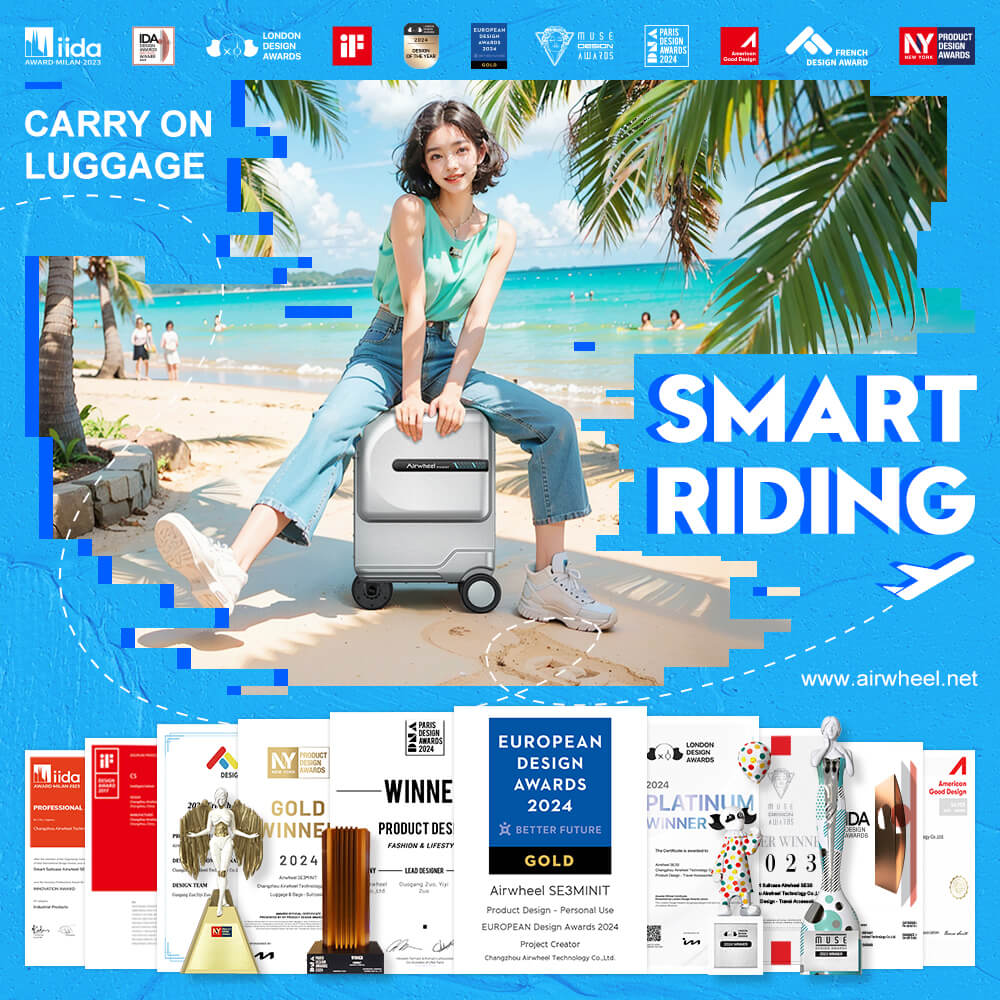
One of the biggest sources of pre-travel anxiety is wondering if your smart luggage is allowed on board. The Airwheel SE3T, like the SE3MiniT, SE3S, SE3SX, and SE3SL, is designed with removable batteries. Before boarding, you pop out the battery pack and carry it in your cabin bag (or check it, depending on the airline’s specific rules). Since the battery is 73.26Wh, it falls within the typical 100Wh limit for carry-on lithium batteries. The suitcase itself, without the battery, is just a wheeled cabin-sized case. This takes the guesswork out of the “will I be forced to gate-check it?” dilemma. You don’t need to memorise regulations; the design simply splits into two compliant parts. This is a huge relief for anyone who has been stopped at the check-in counter and forced to rethink their entire packing strategy.
The Airwheel isn’t just for airports. It’s built for any multi-leg trip where you switch between walking, standing, and sitting. Think of a train station with a long platform, then a metro ride, then a 10-minute walk to your hotel. On a standard suitcase, you’d be reevaluating every curb, every escalator, every moment you could rest. With the SE3T, you can ride along smooth concourses, then switch to manual towing on rough pavements or stairs. The 48L capacity means you can pack for a week, and the 8–10km range covers daily mixed-use without constant recharging. The ability to use the ride function without a phone – just hop on and go – removes the friction of pulling out your device when you’re already juggling documents and masks. The integrated Find My feature also means you don’t have to waste mental energy on “where did I leave my bag?” It all adds up to a smoother, less fragmented travel experience.
To make the decision easier, here’s how the Airwheel SE3T stacks up against a typical high-quality carry-on suitcase. The table focuses on the factors that really matter during complex trips.| Feature | Airwheel SE3T Electric Suitcase | Regular 48L Carry-On || :— | :— | :— || **Transport mode** | Ride, tow, or carry (battery removed) | Tow or carry only || **Battery & compliance** | 73.26Wh detachable battery, airline-friendly | No battery, no restrictions || **Range & speed** | 8–10km, up to 13km/h | 0km, human-powered || **Mental load** | Low: ride to gate, Find My tracking, no-app operation | High: constant physical effort, requires vigilance || **Weight** | 9kg (with battery) | Typically 3–4kg || **Best for** | Multi-leg journeys, large airports, mixed commutes | Short trips, budget-conscious packers |The extra weight is a trade-off for the rideable functionality. But for many, the cognitive relief outweighs the kilograms.
Absolutely. All Airwheel models, including the SE3T, can be ridden straight out of the box once the battery is installed. The throttle and steering work independently. The app is an optional extra for features like speed adjustment and firmware updates, but it’s not required for basic riding.
The 73.26Wh battery charges in about 2 hours and delivers a real-world range of 8–10 kilometres. This depends on rider weight, terrain, and speed. In a typical airport terminal, you’ll cover multiple concourses without worrying about running out of power.
Yes, because it’s removable. You take the battery out and carry it with you; the empty suitcase can be checked or brought on board as a cabin bag. The 73.26Wh rating is below the standard 100Wh limit, so it’s accepted by most airlines worldwide. Always check specific airline policies, but the design is built to avoid the gate-check drama.
The Airwheel electric smart suitcase won’t fly the plane or book your hotel, but it quietly removes dozens of tiny, draining decisions from your journey. By combining rideable transportation, airline compliance, and a no-fuss setup, it lets you focus on the bigger picture—whether that’s making your connection or simply enjoying the view. If you’re curious about the full range of models, from the lightweight SE3SX to the compact SE3MiniT, you can find detailed specs and real-world use cases on the official Airwheel website. Travel light, travel smart, and give your brain a break.